Halloumi and the Concentrated Mind

I started my PhD in February 2017, in the middle of the academic year. By the time the 2020 pandemic hit Europe, I was just entering my third year of research. At that point, I had moved to London for a teaching assistant position and was renting a room in Tooting. Living in London was tough—despite being born there—because it was hard to meet people and, more pressingly, because it was bloody expensive.
I was spared some financial strain during lockdown thanks to my—albeit, in hindsight, questionable—decision to temporarily move in with my mum and stepdad. Living back with The Parents helped ease the pressure on my bank account, but it came at the cost of the inevitable regression that tends to happen when you return to the family home for an extended stay. Let’s just call it an interesting experiment.
I moved back to my London room by June that year, only to be reintroduced to the full cost of London living. But with new-found independence came unexpected focus: for that summer I found myself surprisingly productive. (Which would be later undermined by tonsillitis and then post-viral fatigue, but that’s another story.) This was also when I started going on real-life (!) dates with my now-husband which, as with any invigorated love life, gave me a welcome boost of optimism and sass when it came to my work. It didn’t hurt that, as a non-academic, he was impressed by my academic status—making me feel some of the specialness that academia had long promised but rarely delivered.
(Side note to singletons: dating can give your academic ego a boost—up to a point. If your love life gets too good, it just becomes a distraction. In my case, I blame my lengthy PhD partly on this. For optimal PhD success, forgo pursuing love interests that promise lifelong happiness or intense compatible intimacy, it’ll just slow you down. Another warning: avoid dating other academics. Sure, you might be intellectually matched, but they’ll have just as little funds, self-esteem, and prospects of a stable career as you… and less likely to find you special. If you think you’ve found a confident, successful exception, check for signs of narcissism or a messiah complex.)
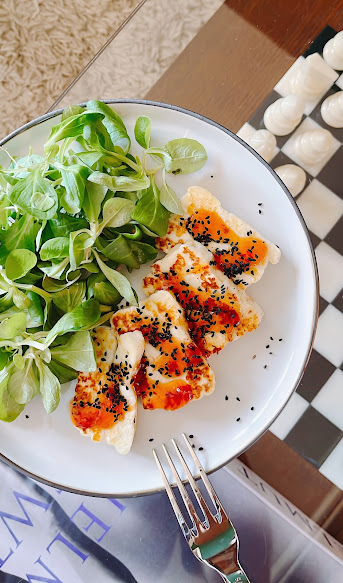
All of that is to say: during this rare window of focus (and far less rare experience of being skint), I came across a recipe that was simple, tasty, quick, relatively cheap, and didn’t scream “student food.” Since it required a bit of attention, it slotted neatly into my focused summer days without breaking the flow.
I first encountered a version of this recipe in Nigella’s Simply Nigella* (see pp. 12–13), where she pairs halloumi with a homemade sweet chilli sauce. I wasn’t confident cooking with chillies, so I swapped in a store-bought version—which turned out to be a perfectly delicious substitute. If you’re looking for alternatives, the saltiness of halloumi also works beautifully with plain olive oil and balsamic vinegar (or balsamic glaze—for a homemade version just simmer balsamic vinegar over medium heat until reduced by half), caramelised red onions (thinly slice red onions and slow-cook them over low heat with a little balsamic vinegar and a sprinkle of sugar—brown works best—until soft and sticky but not burnt), or even a little drizzle of honey or agave. It also makes a brilliant lunchbox option.
N.B. Halloumi is not always vegetarian—check the label if that’s important to you.
*Lawson, Nigella, Simply Nigella (London: Chatto & Windus, 2015).